

News
An inclusion ecosystem approach: the importance of getting everyone on board for systemic change
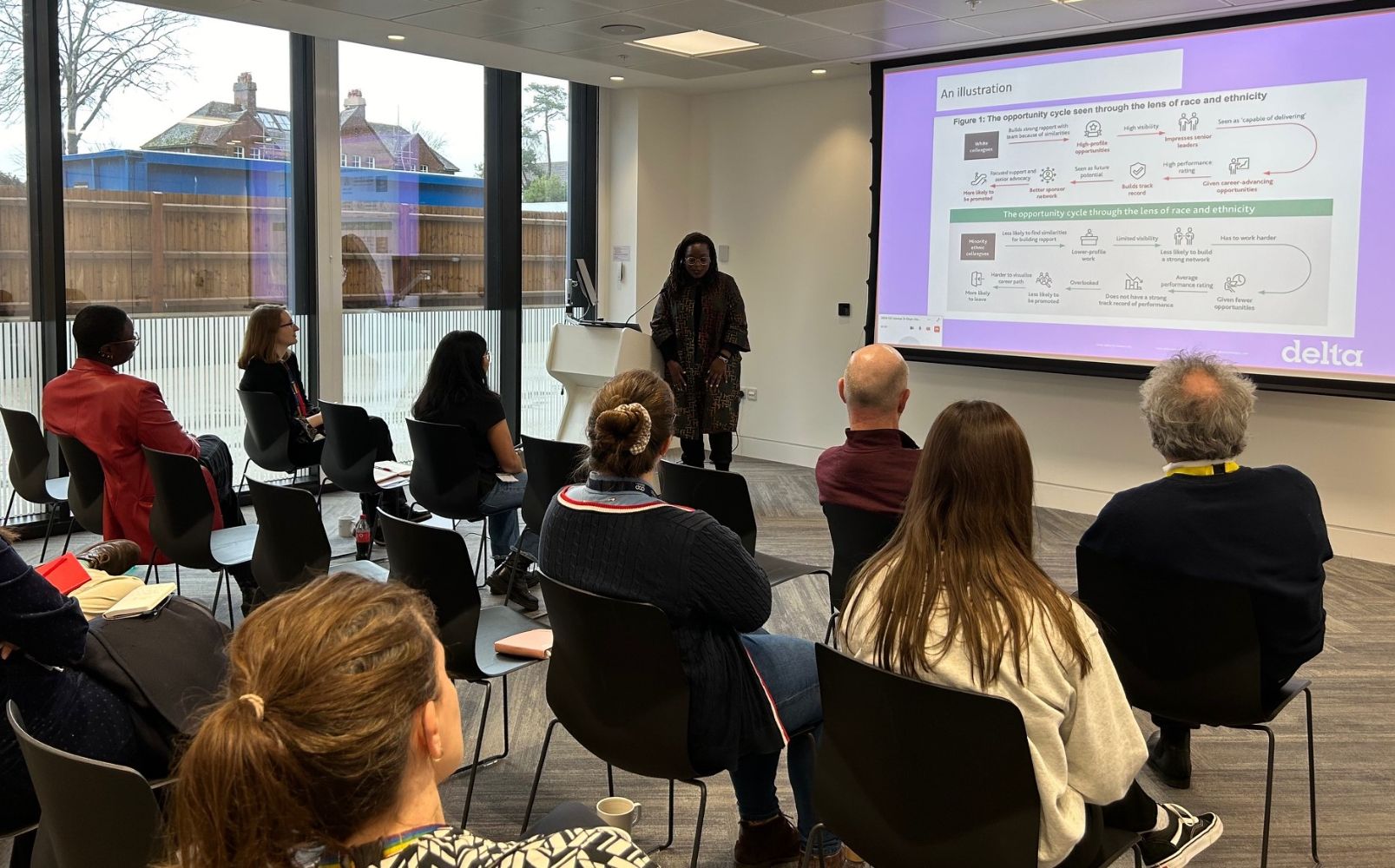
The Institute of Developmental & Regenerative Medicine continued its EDI seminar series on Friday 9th February by welcoming speaker Dr Doyin Atewologun, Delta Consulting, and Oxford University.
Students, researchers and support staff working at the IDRM, the Department of Physiology, Anatomy and Genetics, the Department of Paediatrics, and other institutes on Old Road Medical Campus gathered in person and online to hear Dr Atewologun’s seminar, ‘An Inclusion Ecosystem© approach to building equitable cultures: the importance of getting everyone on board for systemic change’.
There was laughter as she flipped the race and ethnicity lens during a role play session and ‘interviewed’ two job candidates from the audience with different genders and ethnicities, favouring one candidate that she related to over the other who had a different gender and ethnicity to her. This was a simple, but very powerful way to demonstrate the difference in career opportunities that are normally afforded to white versus minority ethnic individuals and the impact it has on an individual’s sense of belonging. She emphasised that we need to embrace uniqueness to become truly inclusive.
Her overarching ethos was that ‘the system’ is not ‘out there’, it is in every one of us and therefore each of us has the power to effect meaningful change. She spoke of moving from a fixed to a growth mindset and facing discomfort head on, using examples of changing your thinking from ‘Nothing is going to change’ to ‘I’m going to use my voice and platform’ before inviting attendees to consider what their next action is going to be as a member of the Inclusion Ecosystem©.
We are incredibly thankful to Dr Atewologun for her engaging and inspirational insights, so much so that we asked for her thoughts on some of the questions that have been raised along our EDI journey:
Q. ‘Inclusion’ has become such a cultural buzzword over the last decade particularly. How would you defend its importance for naysayers?
In my work, I see a lot of people get ‘inclusion’ confused with words like ‘diversity’, ‘positive action’ and even ‘discrimination’. But when you think about what inclusion actually means, that is, encompassing both recognising and valuing differences among individuals, as well as fostering a sense of belonging and commonality within the group, it is difficult to challenge its worth. When people with different backgrounds and experiences feel valued, respected, and empowered to contribute their unique talents and insights, the associated benefits for the individual, team and organisation are numerous, including enhanced problem-solving and creativity, increased job satisfaction, and employee engagement and retention.
Q. In your experience, what hard questions do you think organisations are not asking themselves when it comes to inclusion?
I think it is easy for organisations to focus on indicators of ‘diversity’, like proportional representation and targets and stop there. The harder questions go beyond whether you have a diverse leadership, management pipeline or early career cohort, to focus on the culture fostered. Organisations also need to ask the hard questions like:
“Do we have a diverse talent pipeline to leadership?”
“Are our retention rates similar across different groups?”
“Does everyone experience the same level of engagement across various dimensions of difference?”
Organisations may also overlook other hard questions such as the extent to which their solutions take account of intersectionality. For example, are your LGBTQI+ inclusion solutions accessible? Are your gender programmes benefitting women from minoritised ethnic or religious communities? Such questions focus on an organisation’s culture of inclusion, and their efforts in striving for equitable processes – these are tougher to address and fix than numbers.
Q. What does change making look like on an individual level for anyone committed to equity and equality in a workspace?
On an individual level, change-making for equity and equality involves actively challenging biases (remember we don’t just have negative biases but positive biases/favouritism too), understanding why advocating for equity and equality is good for you (not just ‘others’/’Othered’ folk), listening to and amplifying underrepresented voices, and continuously educating oneself on issues, topics and challenges unfamiliar to us. For example, bearing in mind the prevailing geopolitical context, I am learning more about history as well as how ethnicity, religion and proximity to whiteness play out in conflicts and biases across the world.
Change also looks like speaking up against injustice and being willing to confront discomfort, resistance and being skilled at how to address biased or inconsistent logic/thinking in order to draw attention to inequities around us. For example, it is not unusual for business leaders advocating for gender equality to be asked “What difference or what value do women bring to leadership roles or your boards?” and being challenged about ‘the business case’. But how often do the same people get asked “What difference or what value do men bring to leadership roles or your boards?”. So why do we want to justify the presence of women in leadership roles when men have never had to justify their overrepresentation in leadership? Questions such as this helps us see and challenge some of the assumptions we have about the status quo.
Q. In your experience, how long does change take?
Behavioural and institutional change is often slower than we would like, and sometimes we need to remind ourselves to focus on ‘progress’ over ‘perfection’. While some progress can be achieved relatively quickly through targeted initiatives and training/learning programs that raise awareness and provide practical tools for behaviour and system change, a long-term view incorporating ongoing evaluation and adjustment is necessary to ensure continued progress – and at Delta, we communicate this imperative to our clients. Change is fast-tracked by leaders’ commitment and degree of attention to systemic level change (e.g. scrutinising informal and formal processes that lead to inequitable outcomes rather than just stating on a website that you strive to be an inclusive and diverse organisation). Again, this is something we support and challenge our clients to focus on.
Q. If someone wrote a book about you what would the title be?
“They said ‘zig’, but she went ‘zag’: Charting your own path to authentic leadership.”
Q. If you had to choose a favourite movie villain and hero, who would they be and why?
Favourite villain and hero would be the same person: Omar Little in the HBO series, The Wire. Omar (portrayed by the late Michael K. Williams) is a principled ‘stick-up’ man (he robs street-level drug dealers). It is not unusual for me to quote Omar; he has a sophisticated understanding of the politics of the systems in which he is embroiled, and the rules for upholding and somehow even thriving therein, while gaining respect from others in doing this. Some of his quotable quotes include: ‘A (wo)man’s got to have a code’ and ‘It’s all in the game’. Politics exists everywhere – being able to spot and decode power as it is wielded in different ‘plays’ and by different ‘actors’ in organisations (as well as academia) has proved very beneficial for me, on occasion!
About the speaker:
Dr Doyin Atewologun is the founder and CEO of Delta, a niche leadership and inclusion consultancy and was former Dean of the Rhodes Scholarships at the University of Oxford. She remains an advisor to the Rhodes Trust and has an Honorary Fellow position at Trinity College. She previously held the position of Director of the Gender, Leadership & Inclusion Centre at Cranfield School of Management and Reader. She won Inspiring Board Leader of the Year at the 2019 Precious Awards and was recognised in People Management magazine’s Top 20 Diversity and Inclusion ‘Power List’ in 2020, as well as winning a number of other awards for academic excellence.