

News
IDRM Researchers inspire local families at Science in the Park event
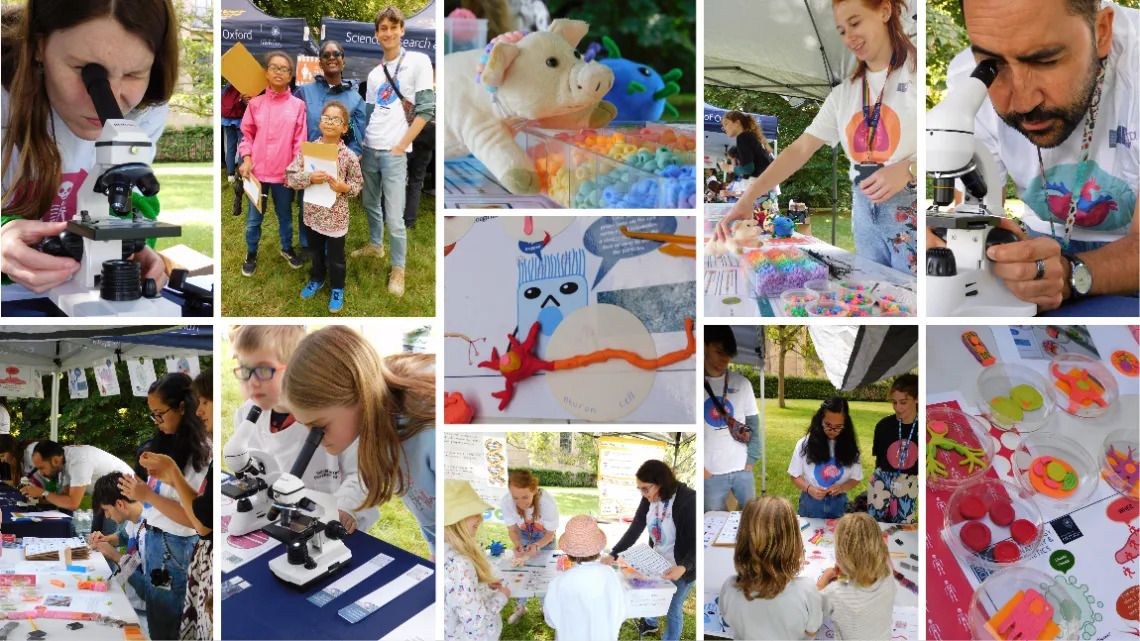
On Tuesday, 25 July, more than 140 children, together with around 60 parents and caregivers, were treated to a thrilling variety of hands-on science activities in University Parks. ‘Science in the Park’ was run by DPAG’s Outreach and Public Engagement Working Group (OPEWG), in collaboration with the Department of Biochemistry, with 30 volunteers comprising research scientists, graduate students and professional services staff.
The collaborative group of volunteers delivered seven hands-on activities, including blood matching, microscopy, making plasticine cells, and drawing neurons. Aimed primarily at children, IDRM, DPAG, and Biochemistry scientists were on hand to answer questions and share fun facts.
The blood-matching activity delivered by researchers based at the Institute of Developmental and Regenerative Medicine (IDRM) was a big hit with adults and children alike. One young boy commented that learning about different coloured blood was really cool, and a caregiver commented that “It’s a great thing that you’ve done here, it was so exciting for the children, and I found it really interesting too. The colour of blood was so surprising!”
DPhil student Hannah Unsworth, who ran the event in the afternoon with fellow student Aaron Johnston, said: "I had a great time delving into the chemical origins of the colour of blood. The children and parents were as shocked as I was about the vast variation across species. They had so many intriguing questions, and it was great to see them interested in science at a young age."
The event also gave children the opportunity to find out what it takes to be a good scientist and even dress up as a scientist to get a real feel for it. DPhil student Jess Livesey, who ran this event in the afternoon with Akansha Mehta, said: "Science in the Park was hugely successful with members of the public, and it was very enjoyable and rewarding to volunteer. It was particularly great to hear from many parents and carers who let us know how much they appreciated the representation of women in science at this event. I would strongly encourage students to get involved with the Outreach & Public Engagement Working Group. It’s great practice in communicating your research to the public and maybe even inspiring the next generation of scientists."
Indeed, one of the caregivers told one of the organisers, Equality, Diversity and Inclusion (EDI) officer Louise Cotterell: “This is lovely, and we’re so pleased to see so many women scientists here; our daughters need to see this to inspire them.”
Special thanks goes to all our volunteers who made this event possible: Ajantha Abey, Ephraim Berthold, Ben Chapman, Susanna Cooper, Claudio Cortes Rodriguez, Alexa Cosma, Louise Cotterell, Kiara Delos, Hugo Fernandes, Amber Foley, Sarah Franks, Emma Hodgkins, Aaron Johnston, Valentine Lagage, Anna Lavayssière, Jess Livesey, Akansha Mehta, Amy Moores, Bethan O'Connor, Gizem Önal, Flair Paradine Cullup, Christophe Ravaud, Andia Redpath, Fiona Sargison, Sarah Sigal, Liliana Som, Chloe Stewart, Susanne Szydlowski (and her son Alvin!), Hannah Unsworth, and Tomoko Watanabe, who we also thank for the photographs. We also extend our thanks to DPAG and IDRM Facilities teams for supplying first aid kits.